Applications
Vehicle wraps and fleet graphics
Vehicle wrap printing needs stable colour, clean panel joins and enough drying time before lamination.
Choose the right wrap film
For full wraps and deep recesses, cast wrap vinyl is the safer print media because it conforms with less tension and keeps shape better over time. Polymeric film suits flatter panels and simpler curves, where the job does not need the same level of stretch and recovery.
Air-release adhesive helps the applicator push out trapped air during fitting, but it does not fix poor print handling. Keep panels clean, avoid edge damage during trimming, and match the laminate type to the base film so the face film and overlaminate move at a similar rate.
Control drying before lamination
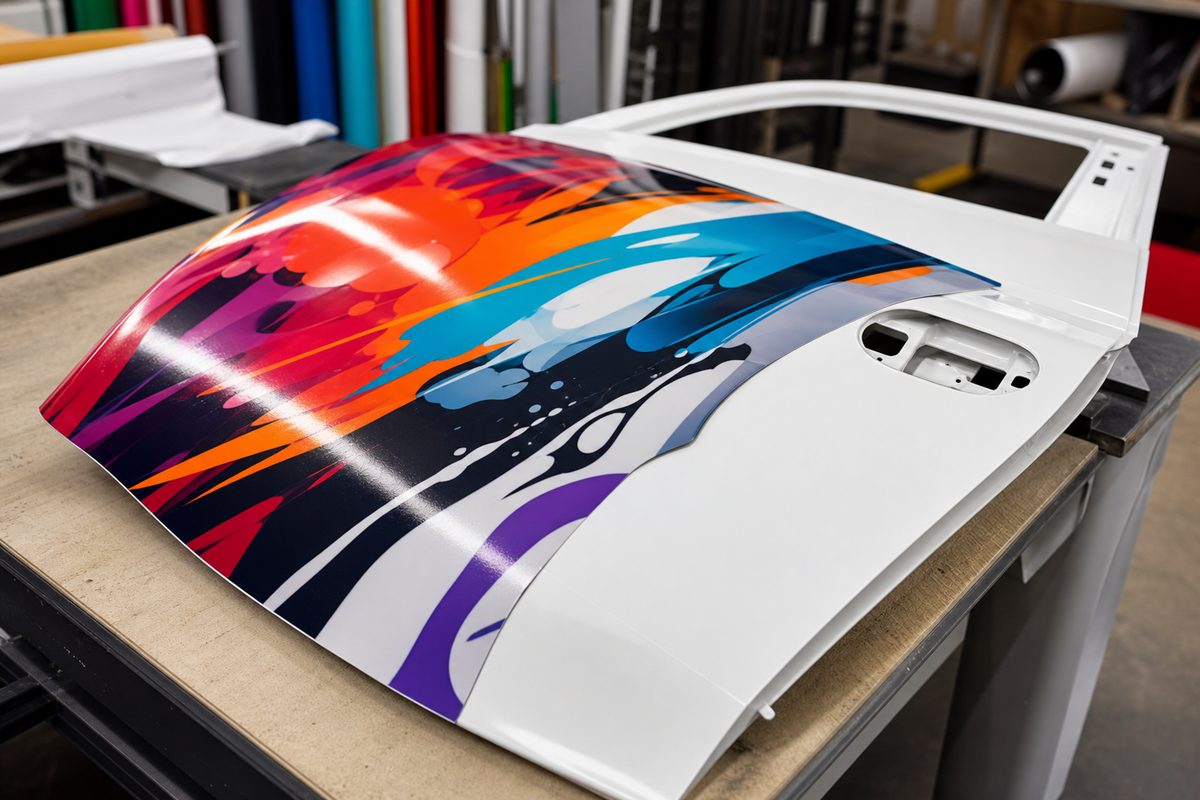
Eco-solvent prints need proper outgassing before lamination. If solvent remains in the print, the laminate can silver, tunnel or lift at stressed areas, and colour may shift slightly after the job has already been panelled and cut.
Drying time depends on ink load, coverage and workshop conditions. Heavy solid areas and dark colours need longer. A practical check is print smell and surface feel, but the safer approach is to allow enough standing time before laminating and contour cutting.
Three habits keep a wrap print ready for laminate:
- Reduce oversaturation in rich fills
- Keep take-up and handling dust-free
- Laminate only when prints have settled
Panel large wrap graphics
Large vehicle sides are normally split into panels that a print and cut workflow can handle consistently.
Set overlap deliberately rather than leaving it to trimming on the bench. Keep text, stripes and key brand elements away from joins where possible. When a design must cross a seam, make sure each panel includes enough shared image area for accurate matching during application.
Keep colour steady across panels
Fleet work shows colour variation quickly because the same artwork repeats across multiple vehicles. Use a stable media profile, consistent heater settings and the same pass mode for every panel in a set. Mixing modes or reprinting single panels later can make density differences stand out.
Before final production, check neutral greys, corporate colours and long gradients for banding or drift. Colour profiling helps keep panel-to-panel output predictable, especially when jobs are reprinted later.
What our Large Format Printing customers say
Verified Google reviews
Wrap film and lamination
Questions on wrap media, laminate, panelling and panel colour are welcome.