Applications
Wallpaper and decor prints
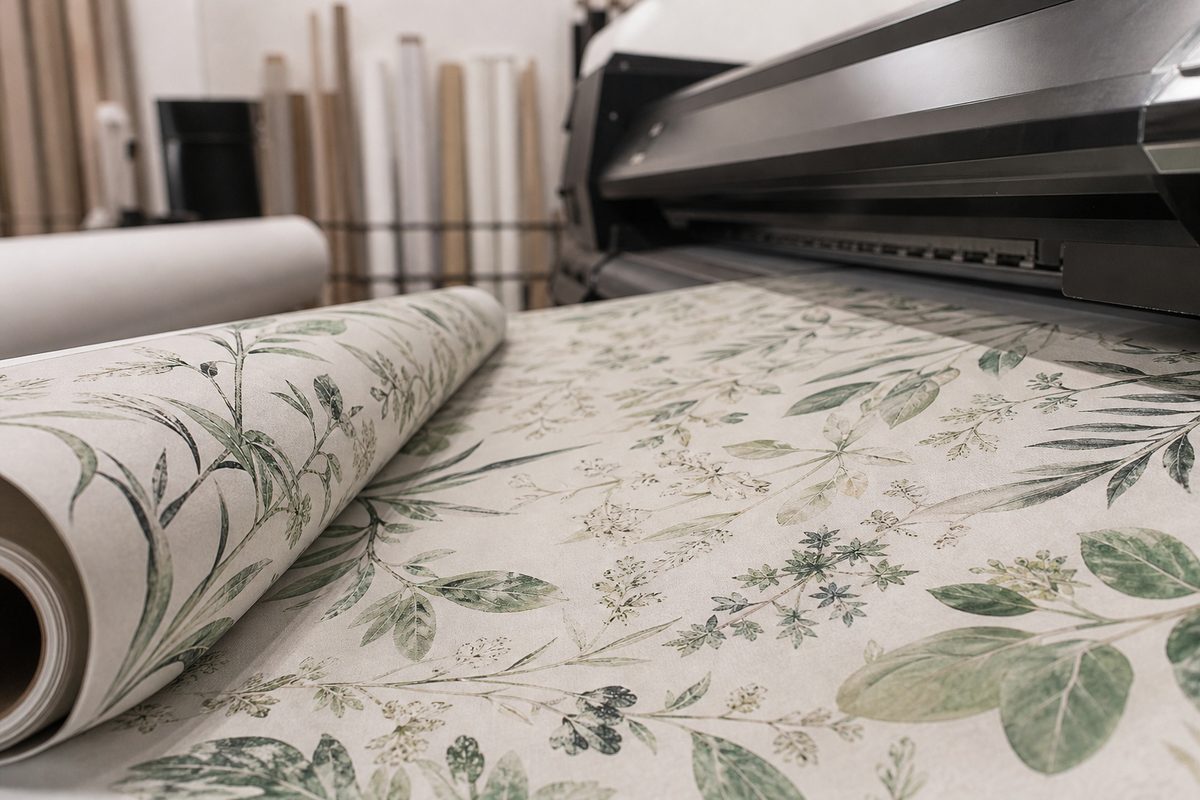
Wallcovering print needs stable colour, clean joins and media that stays flat. Eco-solvent and UV roll printing each suit different décor jobs.
Print method for décor media
Wallpaper and décor work starts with the surface finish and how the print will be fitted. Flexible wallcovering media and canvas go to eco-solvent, where a softer hand and roll handling matter. UV roll printing suits media that need a tougher face or stronger opacity for dense colour and decorative panels.
Before committing to a run, check how the media feeds, how quickly it relaxes after printing and whether the ink load keeps edges flat. On murals, cockling and edge curl make panel alignment harder. A print mode that looks slightly slower on the machine can save time later by keeping joins cleaner and more predictable.
Tiling and overlap control
Large wall graphics are easier to fit when the artwork is divided with a consistent panel width and a planned overlap. Keep the tile order clear in the file and make sure each drop is cropped the same way. If one panel carries a different trim allowance, the image can drift across the wall even when the print quality is good.
Overlap needs to be deliberate, not a last-minute fix for size variation. When the print stretches slightly in one direction, random overlaps show it immediately in patterns and straight lines. Stable feed, correct take-up tension and repeatable panel sizing matter as much as the image itself.
Drops line up on the wall when the tiling is controlled:
- Keep panel widths consistent
- Label drop order clearly
- Use planned overlap only
- Check trim allowance on every tile
Colour match between drops
Wallcoverings are unforgiving when one drop shifts warmer, darker or more saturated than the next. Print the full job in one controlled run when possible, using the same media batch, print mode and ink set. If a reprint is needed later, matching the original profile and environmental conditions helps avoid visible panel changes.
Muted neutrals, skin tones and flat painted backgrounds show mismatch faster than busy artwork. Linearisation, profiling and stable nozzle performance matter here because a small density change across a panel edge can read as a stripe once the mural is up. Regular printhead care helps keep those transitions even.
Finishes for interior graphics
Canvas reproductions, printed murals and décor panels all place different demands on the print. Canvas benefits from controlled saturation so texture is not flooded. Wallpaper media needs enough density to hold colour without making seams obvious. Panel graphics need clean solids and smooth gradients, especially in stone, timber and painted-effect artwork.
The useful checks are media compatibility, surface appearance, expected join visibility and how closely repeat colours need to match across the full set.
What our Large Format Printing customers say
Verified Google reviews
Wallpaper and mural output
Mention the media, drop width and colour issues you deal with on wall graphics.